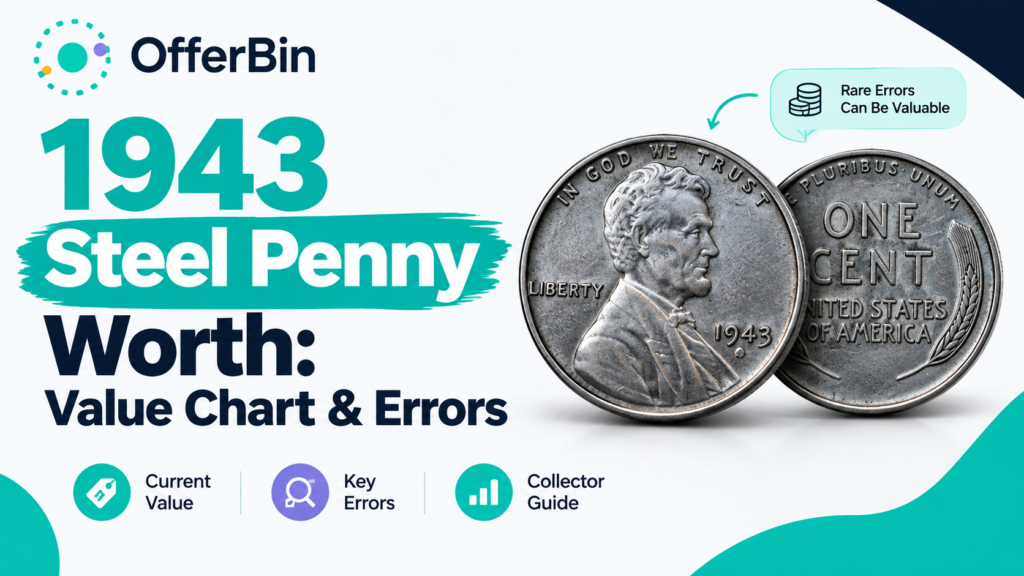
A normal 1943 steel penny is usually worth more than its one-cent face value, but most circulated examples are not rare treasures. The big exceptions are high-grade coins, recognized varieties, and especially the extremely rare 1943 bronze cents. A genuine 1943 steel cent weighs about 2.70 grams and should respond to a magnet because its planchet is zinc-coated steel.
How Much Is a 1943 Steel Penny Worth?
Most ordinary 1943 steel pennies are worth a modest premium over face value, with condition making a major difference. Circulated coins can often trade for well under a dollar to a few dollars, while attractive uncirculated examples can bring substantially more. Certified high-grade coins can reach tens or hundreds of dollars, and exceptional varieties can sell for much more.
As a practical starting point:
| 1943 Steel Penny Condition | Approximate Value Range* |
|---|---|
| Heavily circulated | $0.10–$0.50 |
| Average circulated | $0.25–$1 |
| About Uncirculated (AU) | $1–$5+ |
| Mint State (MS60–MS63) | $5–$20+ |
| MS64–MS65 | $15–$60+ |
| MS66 | $40–$150+ |
| MS67 and higher | $100–$250+ or more |
*These are broad educational ranges, not guaranteed buying or selling prices. Certified examples can differ considerably by mint, grade, eye appeal, variety, and market conditions.
Actual auction records show how strongly grade can affect prices. For example, PCGS records include a 1943 Philadelphia steel cent graded MS66 that sold for $65 and an MS67 example that sold for $185. A 1943-D MS66+ example sold for $85.
So, the first question is not simply “What is a 1943 penny worth?” It is:
What kind of 1943 penny do you have?
That means checking its composition, mint mark, condition, and possible varieties.
1943 Steel Penny Value Chart
The three regular 1943 steel cents were struck at Philadelphia, Denver, and San Francisco.
| Version | Mint Mark | Mintage | Metal | Weight |
|---|---|---|---|---|
| 1943 Philadelphia | None | 684,628,670 | Zinc-coated steel | 2.70 g |
| 1943-D | D | 217,660,000 | Zinc-coated steel | 2.70 g |
| 1943-S | S | 191,550,000 | Zinc-coated steel | 2.70 g |
PCGS lists these mintages and specifications for the regular 1943, 1943-D, and 1943-S cents.
The mint mark by itself does not automatically make one 1943 steel penny valuable. Condition, variety, originality, and whether the coin is a recognized error can matter much more.
Why Does the 1943 Penny Look Silver?
The unusual silver-gray appearance comes from the coin’s wartime composition.
In 1943, the U.S. Mint replaced the normal bronze composition with zinc-coated steel because copper was needed for World War II production. The change lasted for one year before the cent returned to a different copper-based composition in 1944.
That is why a genuine 1943 steel cent can look very different from earlier Lincoln Wheat cents.
The coin is not made from silver.
It is a steel core covered with zinc.
How to Tell If a 1943 Penny Is Steel or Bronze
This is one of the most important checks to make before trying to determine the coin’s value.
Use a Magnet
A normal 1943 steel cent should be attracted to a magnet because of its steel composition.
A genuine 1943 bronze cent will not be magnetic.
However, a magnet test is only a screening test, not authentication.
A non-magnetic 1943 cent is interesting, but it should not automatically be assumed to be a rare bronze error.
Weigh the Coin
A regular 1943 steel cent weighs approximately 2.70 grams. A genuine 1943 bronze cent is heavier, around 3.11 grams.
A useful comparison is:
| Feature | Normal 1943 Steel Cent | 1943 Bronze Cent |
|---|---|---|
| Composition | Zinc-coated steel | Bronze |
| Approx. weight | 2.70 g | 3.11 g |
| Magnetic? | Yes | No |
| Appearance | Gray/silver-colored | Copper/bronze-colored |
| Normal for 1943? | Yes | No — extremely rare error |
The weight difference can be helpful, but a home scale cannot prove authenticity. Altered, damaged, or counterfeit coins can produce misleading results.
Check the Color Carefully
A genuine steel cent normally has a gray or silvery appearance.
A bronze example should have the familiar copper-colored appearance associated with Lincoln cents from surrounding years.
But color alone is not enough.
A steel cent can be discolored, plated, cleaned, or chemically altered. Likewise, a rare-looking copper-colored coin can be altered.
Look at the Date and Mint Mark
Make sure the coin actually reads 1943.
Then check below the date:
- No mint mark = Philadelphia
- D = Denver
- S = San Francisco
The absence of a mint mark on a 1943 cent is normal for Philadelphia; it does not automatically indicate a rare coin.
How Much Is a 1943-D Steel Penny Worth?
A normal 1943-D steel penny was struck at the Denver Mint, with a reported mintage of 217,660,000. It weighs 2.70 grams and uses zinc-coated steel.
Circulated 1943-D cents generally do not command huge premiums simply because they have a D mint mark.
Condition becomes much more important as the grade rises.
For example, PCGS records a 1943-D MS66+ steel cent selling for $85, while a certified MS67 example has had PCGS price-guide values and auction results substantially above ordinary circulated examples.
The 1943-D also has a notable D/D repunched mint mark variety, which is a separate collecting interest from the ordinary 1943-D cent. PCGS identifies the 1943-D/D variety as FS-502/FS-501 depending on the reference designation and lists a substantially higher auction record for a high-grade example.
How Much Is a 1943-S Steel Penny Worth?
The 1943-S was produced at the San Francisco Mint, with a mintage of 191,550,000.
Like the Philadelphia and Denver issues, it is normally a zinc-coated steel cent weighing about 2.70 grams.
The S mint mark alone does not make an ordinary circulated coin extremely rare.
However, the 1943-S has collectible varieties, including a documented Doubled Die Obverse variety. PCGS lists a 1943-S Doubled Die Obverse with an auction record of $716 for an MS65 example.
This illustrates an important point:
A recognized variety can be worth considerably more than a normal coin of the same date and mint.
What Makes a 1943 Steel Penny Valuable?
Several factors can affect the value of a 1943 steel penny.
Condition
A heavily worn coin usually has limited collector value.
A sharply detailed coin with original surfaces, good luster, and little wear can be worth more.
Grade
Professional grading companies assign grades to describe a coin’s condition.
For uncirculated coins, you’ll often see grades such as:
- MS60
- MS61
- MS62
- MS63
- MS64
- MS65
- MS66
- MS67
- MS68
The higher the grade, the more demanding the quality standards become.
Mint Mark
The Philadelphia, Denver, and San Francisco issues have different mintages and collecting characteristics.
The mint mark can also help identify certain varieties.
Errors and Varieties
A recognized mint error or die variety can dramatically change a coin’s value.
Examples include:
- 1943-D/D repunched mint mark
- 1943-S Doubled Die Obverse
- Off-center strikes
- Wrong-planchet errors
- Bronze planchet errors
Original Surfaces
Steel cents are particularly vulnerable to corrosion and surface problems.
A coin that has been cleaned, replated, or otherwise altered may be worth less than a similar coin with original surfaces.
How Does Condition Affect 1943 Steel Penny Value?
Two 1943 steel pennies can look similar at first glance but have very different values.
A circulated coin may show:
- Flattened wheat stalks
- Wear on Lincoln’s hair
- Scratches
- Dents
- Loss of original luster
- Corrosion or spotting
An uncirculated coin should show no wear from circulation, although it can still have marks, discoloration, spotting, or other problems.
Circulated Condition
These are coins that have been used in commerce and show visible wear.
Most ordinary circulated 1943 steel cents fall into this category.
About Uncirculated
An AU coin has only a small amount of wear, often concentrated on the highest points of the design.
These can be worth more than typical circulated examples.
Mint State
Mint State coins have no circulation wear.
That does not mean every MS coin is valuable. A low-end MS coin and a superb gem example can have very different market values.
PCGS auction records demonstrate this spread. A 1943 Philadelphia steel cent graded MS65 sold for $33 in one recorded auction, while MS66 and MS67 examples have recorded substantially higher prices.
What Are the Rarest 1943 Steel Penny Errors?
The most famous 1943 error is actually not a steel penny.
It is the 1943 bronze cent.
Still, several 1943 steel-cent varieties and errors are important to collectors.
| Variety/Error | What It Means | Potential Importance |
|---|---|---|
| 1943-D/D RPM | A repunched Denver mint mark | Collectible recognized variety |
| 1943-S DDO | Doubled Die Obverse | Recognized die variety |
| Off-center strike | Coin was not centered correctly during striking | Value depends on severity and authenticity |
| Wrong-planchet error | 1943 dies struck a planchet intended for another coin | Rare and potentially valuable |
| Bronze planchet | 1943 dies struck a bronze blank | Extremely rare and highly valuable |
The value of an error depends on the exact variety, authenticity, grade, visibility, and collector demand.
Not every coin with a slightly unusual-looking mint mark or design is a valuable error.
What Is a 1943-D/D Steel Penny?
The 1943-D/D is a recognized repunched mint mark variety from the Denver Mint.
PCGS lists it separately from the normal 1943-D cent and identifies the D/D variety as a distinct die variety. Its auction record is far higher than that of an ordinary circulated 1943-D because recognized varieties become much more important in higher grades.
If you think your 1943-D has a doubled or repunched mint mark, compare it with authoritative variety references before assuming it is valuable.
What Is a 1943-S Doubled Die Penny?
The 1943-S also has a documented Doubled Die Obverse variety.
PCGS lists the 1943-S Doubled Die Obverse separately and records an MS65 example selling for $716.
The important distinction is between a genuine doubled die and ordinary damage.
A coin that has been scratched, struck, or damaged after leaving the Mint can develop shapes that resemble doubling.
That is why variety identification should be based on established diagnostic characteristics rather than appearance alone.
How Much Is a 1943 Copper Penny Worth?
This is where the value question changes dramatically.
A normal 1943 cent is supposed to be steel.
A genuine 1943 bronze cent is an extremely rare Mint error.
The U.S. Mint confirms that a limited number of copper pennies were accidentally produced in 1943. NGC documents authenticated examples from Philadelphia, Denver, and San Francisco.
NGC reported that fewer than two dozen Philadelphia examples were known at the time of its 2019 article.
Some authenticated 1943 bronze cents have sold for six-figure prices. For example, NGC reported that the famous Don Lutes 1943 Philadelphia bronze cent realized $204,000 at Heritage Auctions in January 2019, while a 1943-S bronze cent certified by PCGS has an auction record of $504,000.
These are exceptional auction results for authenticated rarities, not a realistic valuation for an ordinary 1943 penny.
Why Is the 1943 Bronze Penny So Rare?
The U.S. Mint changed to zinc-coated steel in 1943 to conserve copper for wartime needs.
The famous bronze errors happened because a small number of bronze planchets were apparently still present when 1943-dated cents were being struck.
NGC describes these as transitional/wrong-planchet errors and notes that only a small number are known.
That is why a genuine 1943 bronze cent is completely different from a normal steel cent.
How to Tell If a 1943 Penny Is Really a Rare Bronze Error
If your 1943 penny:
- Does not stick to a magnet
- Weighs around 3.11 grams
- Has a bronze/copper appearance
- Clearly has a 1943 date
then it may deserve professional examination.
But do not clean it, polish it, scrape it, or try to alter it before authentication.
A rare coin can lose value if its surfaces are damaged.
Professional authentication is especially important because valuable 1943 bronze cents are famous and therefore attractive targets for counterfeiting and alteration.
What About Other 1943 Wrong-Planchet Errors?
The bronze cent is not the only unusual 1943 error.
NGC has documented a 1943 Lincoln cent struck on a planchet intended for a 25-cent coin from Curaçao. That unusual coin weighed about 3.6 grams and was made from silver, making it very different from both the normal 2.7-gram steel cent and the approximately 3.1-gram bronze cent. It later sold for $31,200 at Heritage Auctions in 2021.
This is a useful reminder that unusual weight does not automatically mean “1943 copper penny.”
Different wrong-planchet errors can have completely different characteristics.
How to Spot Cleaned or Reprocessed 1943 Steel Pennies
Steel cents can develop surface problems because their zinc coating can deteriorate.
Be cautious if a coin has:
- An unusually bright artificial appearance
- A strange uniform silver color
- Missing or damaged zinc coating
- Evidence of polishing
- Hairline scratches across the fields
- Unnatural shine
- Blotchy plating
- Corrosion that appears to have been chemically treated
A replated coin is not the same thing as a pristine original example.
If you believe a coin might be rare, avoid aggressive cleaning.
Is a 1943 Steel Penny Rare?
A normal 1943 steel penny is not considered extremely rare simply because it was made in 1943.
More than one billion 1943 Lincoln cents were produced across the three mints. PCGS lists 684,628,670 Philadelphia cents, 217,660,000 Denver cents, and 191,550,000 San Francisco cents.
However, rarity changes dramatically when you move into:
- Very high grades
- Recognized die varieties
- Major mint errors
- Bronze planchets
- Wrong-planchet strikes
That distinction is essential when evaluating a 1943 penny.
Should You Get a 1943 Steel Penny Graded?
Professional grading is not necessary for every 1943 steel cent.
It becomes more reasonable when:
- The coin appears uncirculated
- It has unusually strong detail
- It has attractive original surfaces
- You suspect a recognized variety
- It appears non-magnetic
- Its weight is unusual
- You believe it could be a major error
- You need authentication before selling a potentially valuable coin
For an ordinary worn steel cent, grading fees can be disproportionate to the coin’s value.
For a suspected 1943 bronze error, professional authentication is much more important.
How Much Is a 1943 Steel Penny Worth Today?
The answer depends on the individual coin.
A normal circulated steel cent generally has a modest collector premium. Better-preserved examples can be worth several dollars or more, while certified high-grade coins can reach tens or hundreds of dollars.
Rare varieties and major errors are a different category entirely.
For example, PCGS records high-grade regular 1943 steel cents selling from tens of dollars into the hundreds, while recognized varieties and exceptional errors can reach much higher prices.
Because coin prices change, an old price list should not be treated as a guaranteed current selling price.
The best approach is to identify the exact coin first and then compare it with recent sales of genuinely comparable examples.
What Should You Check Before Selling a 1943 Penny?
Use this checklist:
- Confirm the date: Make sure it is actually 1943.
- Check the mint mark: Look for no mint mark, D, or S.
- Test magnetism: A normal steel cent should attract a magnet.
- Weigh it: A normal steel cent should be about 2.70 grams.
- Inspect condition: Look for wear, scratches, corrosion, and original luster.
- Look for varieties: Pay particular attention to recognized D/D and doubled-die varieties.
- Do not clean it: Cleaning can damage collector value.
- Authenticate unusual examples: Especially any non-magnetic 1943 cent.
- Compare actual sales: A price guide is not the same as a guaranteed offer.
- Consider professional grading: Only when the potential value justifies the cost.
Frequently Asked Questions About 1943 Steel Pennies
How much is a 1943 steel penny worth?
Most ordinary circulated 1943 steel pennies are worth a modest premium over face value, while uncirculated and certified high-grade examples can be worth considerably more. Rare varieties and errors can command substantially higher prices. Exact value depends on mint mark, grade, surface quality, variety, and authenticity.
How much does a 1943 steel penny weigh?
A normal 1943 steel Lincoln cent weighs approximately 2.70 grams. PCGS lists a 2.70-gram weight for the regular Philadelphia, Denver, and San Francisco issues.
How do you tell if a 1943 penny is steel?
A normal 1943 steel penny is magnetic and weighs about 2.70 grams. It also has a gray or silver-colored appearance caused by its zinc-coated steel composition. A magnet and accurate scale can help with initial identification, but they cannot authenticate a rare error.
Are all 1943 pennies steel?
No. Almost all 1943 cents were supposed to be zinc-coated steel, but a small number were accidentally struck on bronze planchets. The U.S. Mint and NGC both document these rare 1943 bronze cents.
How much is a 1943-D steel penny worth?
A normal circulated 1943-D steel penny generally has a modest value, while higher-grade examples can be worth significantly more. The D/D repunched-mint-mark variety is a separate collectible variety and can command much higher prices in strong grades.
How much is a 1943-S steel penny worth?
A normal 1943-S steel cent is generally worth a modest premium in circulated condition, with higher-grade examples bringing more. Recognized varieties, including the 1943-S Doubled Die Obverse, can be substantially more valuable.
Is a 1943 steel penny rare?
The ordinary 1943 steel penny is not exceptionally rare because more than one billion were struck. The rare coins are particular high-grade examples, recognized varieties, and especially the 1943 bronze and other major wrong-planchet errors.
What makes a 1943 steel penny valuable?
The biggest factors are condition, mint mark, recognized varieties, errors, originality, and authentication. A normal worn steel cent and an authenticated high-grade error coin can have dramatically different values.
What is the rarest 1943 penny?
The 1943 bronze cents are among the most famous and valuable 1943 errors. Authenticated examples are known from Philadelphia, Denver, and San Francisco, with only a very small number known.
Can a 1943 steel penny be worth thousands?
An ordinary circulated steel cent generally is not worth thousands. However, rare authenticated varieties and major errors can reach thousands or far more. The famous 1943 bronze cents have recorded six-figure auction results.
Should I clean my 1943 steel penny before selling it?
No. Cleaning can leave scratches or other surface damage and may reduce collector appeal. If you think the coin could be rare, preserve its current condition and have it evaluated before attempting any cleaning.
So, What Is a 1943 Steel Penny Worth?
For most people, the answer is straightforward: a normal circulated 1943 steel penny is worth a modest amount above face value, not thousands of dollars.
The value can rise when the coin is:
- In unusually high grade
- An attractive uncirculated example
- A recognized die variety
- A major mint error
- A genuine 1943 bronze cent
- A rare wrong-planchet strike
If you have a 1943 penny, start with the basics: check the mint mark, test it with a magnet, weigh it accurately, and inspect the condition. If it is non-magnetic or otherwise unusual, don’t assume it is valuable based on appearance alone. Professional authentication is the safer next step.
For additional market-focused guides and resources, you can also explore OfferBin.