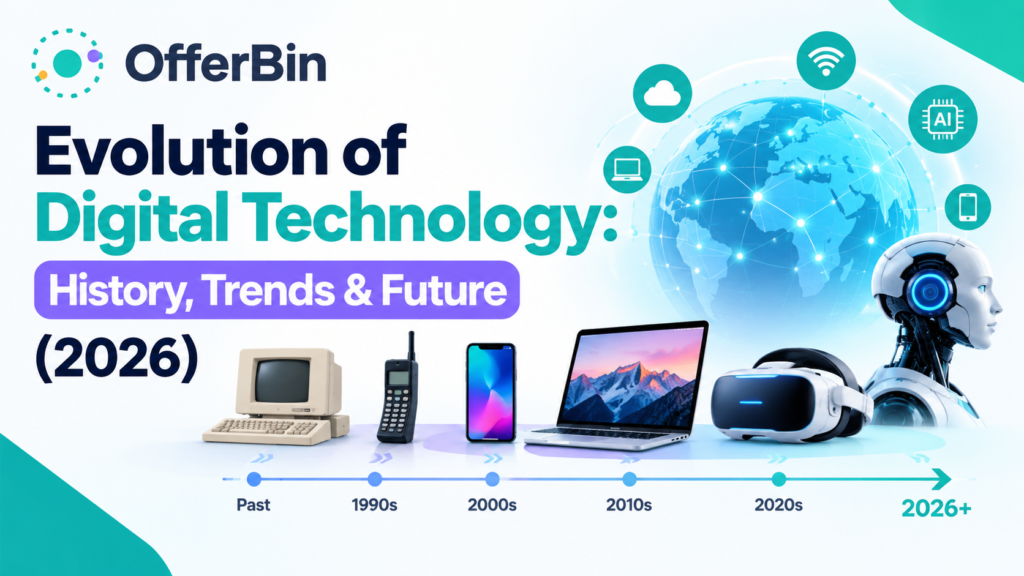
Digital technology has evolved from large electronic computers and basic digital systems into an interconnected environment powered by cloud computing, artificial intelligence, automation, connected devices, and increasingly decentralized technologies. The evolution of digital technology is not simply a story of faster devices. It is the progression from processing information to connecting, analyzing, automating, and increasingly exchanging digital value.
Quick Answer: What Is the Evolution of Digital Technology?
The evolution of digital technology describes the gradual development of technologies used to create, process, store, communicate, and analyze digital information. Major stages include electronic computing, personal computers, the Internet, mobile devices, cloud computing, big data, artificial intelligence, and emerging technologies such as blockchain, edge computing, and advanced automation.
How Has Digital Technology Evolved?
Digital technology has developed through several major stages:
| Era | Major Development | What Changed |
|---|---|---|
| Early computing | Electronic computers | Automated complex calculations |
| Semiconductor era | Transistors and integrated circuits | Smaller and more efficient electronics |
| PC era | Microprocessors and personal computers | Computing became widely accessible |
| Internet era | Web and networking | Information became globally connected |
| Mobile era | Smartphones and mobile apps | Computing became portable |
| Cloud era | Cloud computing | Computing resources became scalable and remotely accessible |
| Data era | Big data and analytics | Organizations could process enormous datasets |
| AI era | Machine learning and generative AI | Software became increasingly capable of recognizing patterns and generating content |
| Connected era | IoT and edge computing | Physical devices became connected and increasingly intelligent |
| Decentralized era | Blockchain and digital assets | New approaches to digital records, ownership and value transfer emerged |
These stages overlap. New technologies rarely replace everything that came before them. Instead, they often build on earlier infrastructure.
What Is the History of Digital Technology?
The history of digital technology stretches across many decades, but several developments fundamentally changed how people interact with information.
Early Electronic Computing
Early electronic computers were designed primarily for specialized calculations and data processing. They were large, expensive systems that required substantial physical infrastructure.
Their importance was not their convenience. It was the demonstration that electronic systems could automate calculations at speeds far beyond manual methods.
This established the foundation for modern computing.
Transistors and Integrated Circuits
The development of the transistor dramatically changed electronic engineering.
Transistors could perform switching and amplification functions while being much smaller and more efficient than earlier vacuum-tube technologies.
Integrated circuits then allowed multiple electronic components to be placed together on a small semiconductor.
This miniaturization became one of the most important forces behind the evolution of digital technology.
Microprocessors and Personal Computers
The microprocessor brought significant computing capability into a compact chip.
As personal computers became increasingly available, computing moved beyond specialized laboratories and large organizations.
Businesses, schools and households could use computers for:
- Word processing
- Spreadsheets
- Databases
- Programming
- Communication
- Research
- Digital media
Computing was becoming a general-purpose technology rather than a specialized industrial resource.
The Internet and World Wide Web
The Internet changed digital technology by connecting computer systems across networks.
The World Wide Web made that connectivity much easier for ordinary users to navigate and use.
Information that once existed in isolated locations could increasingly be accessed from anywhere with an Internet connection.
This created the foundation for:
- Search engines
- Websites
- Online publishing
- E-commerce
- Social media
- Cloud services
- Digital communities
The Internet therefore did more than make computers communicate. It changed how digital information was distributed.
Smartphones and Mobile Computing
Smartphones combined computing, communication, cameras, sensors, applications and Internet connectivity in portable devices.
This shifted computing from a primarily desktop activity toward an always-connected experience.
Mobile technology also created new ecosystems around:
- Mobile applications
- Digital payments
- Location services
- Streaming
- Social platforms
- Mobile commerce
- Digital identity
The smartphone became an important interface between people and the broader digital ecosystem.
From Digitalization to Digital Transformation
Digitalization and digital transformation are related but different concepts.
Digitalization generally involves using digital technologies to improve an existing process.
For example, replacing paper records with a digital database is a form of digitalization.
Digital transformation is broader. It can involve changing how an organization operates, serves customers, makes decisions, develops products and uses technology.
The distinction matters because buying new software does not automatically create meaningful digital transformation.
A business can have modern technology while maintaining outdated processes.
Effective transformation usually requires changes in:
- Processes
- Data
- Technology
- Skills
- Security
- Organizational culture
- Customer experience
What Technologies Are Driving the Evolution of Digital Technology?
Modern digital technology is being shaped by several interconnected technologies rather than one single innovation.
Artificial Intelligence
Artificial intelligence allows computer systems to perform tasks associated with capabilities such as pattern recognition, prediction, language processing and decision support.
AI has become particularly significant because it can operate across many existing technologies.
It can be combined with:
- Cloud computing
- Big data
- Robotics
- Cybersecurity
- Search
- Software development
- Customer-service systems
- Connected devices
Generative AI extends this evolution by allowing systems to produce text, images, audio, code and other forms of content.
Machine Learning
👉Machine learning is a major branch of AI in which systems learn patterns from data rather than relying entirely on manually written rules.
Machine learning is used in areas such as:
- Recommendation systems
- Fraud detection
- Image recognition
- Forecasting
- Search
- Natural-language processing
- Anomaly detection
The importance of machine learning is closely connected to the growth of available data and computing power.
Cloud Computing
Cloud computing changed how organizations access computing infrastructure.
Instead of maintaining every server and computing resource locally, organizations can obtain computing, storage and other services through cloud infrastructure.
Cloud technology supports:
- Scalable applications
- Remote collaboration
- Data storage
- AI workloads
- Software services
- Business analytics
- Digital platforms
It also provides infrastructure for many other technologies in this article.
Internet of Things
The Internet of Things connects physical objects and devices to digital networks.
Examples include:
- Industrial sensors
- Smart appliances
- Connected vehicles
- Wearable devices
- Environmental sensors
- Smart building systems
IoT creates a bridge between the physical and digital worlds.
Big Data Analytics
Modern systems generate enormous amounts of information.
Big data technologies help organizations collect, process and analyze information at scales that would be difficult to manage using traditional systems.
The value does not come simply from having more data.
Useful data must be:
- Relevant
- Accurate
- Secure
- Properly structured
- Interpreted in context
This is why big data and AI increasingly develop together.
Automation
Automation allows software or machines to perform tasks with limited human intervention.
Traditional automation often followed predefined rules.
Modern intelligent automation can combine software, machine learning, data analysis and AI to handle more complex processes.
This can change everything from manufacturing to administrative workflows.
Cybersecurity
As digital systems become more connected, protecting them becomes increasingly important.
Cybersecurity covers areas such as:
- Identity
- Access control
- Encryption
- Network security
- Application security
- Threat detection
- Data protection
- Incident response
Technology evolution therefore creates both new capabilities and new security challenges.
Blockchain Technology
Blockchain represents another important stage in digital technology because it approaches digital records differently from conventional centralized databases.
A blockchain can provide a distributed record of transactions or other data, depending on how the system is designed.
Bitcoin demonstrated the use of blockchain technology for a decentralized digital currency system.
Later blockchain platforms expanded the concept through programmable systems, smart contracts and decentralized applications.
For OfferBin readers, this is an especially important part of the broader evolution of digital technology because blockchain connects computing, cryptography, networks and digital assets.
How Do These Technologies Work Together?
Modern digital innovation increasingly comes from technology convergence.
For example:
Cloud computing + AI
Provides scalable infrastructure for machine-learning and generative-AI workloads.
IoT + edge computing + AI
Allows connected devices to process information closer to where it is generated.
Big data + machine learning
Allows large datasets to become inputs for prediction, classification and automation.
Blockchain + cryptography + networks
Creates systems for distributed records and digital transactions.
AI + cybersecurity
Can help identify patterns and anomalies associated with security threats.
The important point is that technologies do not evolve independently.
A breakthrough in one area can accelerate progress in another.
From Digital Information to Digital Value
One of the most interesting developments in the evolution of digital technology is the transition from simply digitizing information toward representing and transferring digital value.
The progression can be viewed as:
Digitize information
↓
Connect information
↓
Store information at scale
↓
Analyze information
↓
Automate decisions
↓
Create digital services
↓
Represent and transfer digital value
Blockchain and digital assets are part of this later stage.
Traditional databases made digital records highly useful, but blockchain introduced a different model for maintaining certain types of shared records across distributed networks.
This does not mean blockchain replaces conventional databases. Different systems solve different problems.
Where Does Blockchain Fit Into the Evolution of Digital Technology?
Blockchain is best understood as one branch of the broader digital-technology evolution rather than a replacement for all previous technologies.
Bitcoin and Distributed Ledgers
Bitcoin introduced a decentralized system for transferring digital units without relying on a conventional central administrator to maintain the transaction history.
Its design combines:
- Cryptography
- Networking
- Consensus
- Distributed data
- Economic incentives
Bitcoin therefore represents a convergence of several existing technological concepts.
Smart Contracts
Later blockchain platforms introduced programmable smart contracts.
A smart contract can execute predefined logic on a blockchain network.
This expanded blockchain’s potential applications beyond simple digital currency transactions.
Digital Assets
Blockchain networks can support different types of digital assets and tokens.
Their characteristics vary substantially depending on the network and application.
Some systems are designed for payments, some for utility, some for governance, and others for representing digital or real-world assets.
This is why “crypto” should not be treated as one uniform technology.
Why Does Digital Technology Keep Evolving So Quickly?
Several forces contribute to rapid technological change.
Computing Power
More capable processors enable increasingly complex applications.
Data Availability
Digital systems continuously generate new information that can be processed and analyzed.
Network Connectivity
Faster and broader networks allow devices and services to communicate more efficiently.
Cloud Infrastructure
Cloud services make advanced computing resources more accessible and scalable.
AI Development
AI can accelerate software development, research, automation and information processing.
Commercial Competition
Companies continually develop new products and services to differentiate themselves.
Consumer Expectations
People become accustomed to faster, simpler and more connected digital experiences.
Technology Convergence
The combination of multiple technologies can create capabilities that were difficult to achieve with any one technology alone.
Traditional Technology vs. Modern Digital Technology
| Traditional Model | Modern Digital Model |
|---|---|
| Standalone systems | Connected ecosystems |
| Manual processes | Automated workflows |
| Local infrastructure | Cloud and distributed infrastructure |
| Limited data | Continuous data generation |
| Periodic analysis | Real-time or near-real-time analytics |
| Fixed software functions | AI-assisted adaptive systems |
| Centralized information | Centralized and decentralized architectures |
| Physical records | Digital records |
| Human-only workflows | Human-machine collaboration |
Modern does not automatically mean better.
A newer system can introduce additional costs, security risks, complexity or dependency.
The right technology depends on the problem being solved.
Why Does Digital Innovation Matter?
Digital innovation matters because it changes how information and services are created, distributed and consumed.
It can help organizations:
- Automate repetitive processes
- Analyze information more efficiently
- Reach users through digital channels
- Improve collaboration
- Develop new services
- Connect physical and digital systems
- Create new business models
But technology alone does not guarantee better outcomes.
A poorly designed digital system can make an existing problem more complicated.
The useful question is therefore not:
“Is this technology new?”
It is:
“Does this technology solve a meaningful problem better than the available alternatives?”
What Are the Benefits of the Evolution of Digital Technology?
Faster Information Processing
Digital systems can process large amounts of information much faster than manual methods.
Greater Connectivity
The Internet and mobile networks allow people, organizations and devices to communicate across geographic boundaries.
Improved Access to Information
Search engines, online databases, digital libraries and cloud platforms have made information easier to access.
More Automation
Software can automate repetitive processes and increasingly support complex workflows.
Better Data Analysis
Analytics and AI can help identify patterns in large datasets.
New Digital Services
Streaming, cloud software, digital payments, online education and many other services became possible because digital infrastructure evolved.
New Forms of Digital Value
Blockchain and token-based systems introduced additional ways of representing and transferring digital assets.
What Are the Challenges of Digital Technology?
Technological progress also creates problems that organizations and individuals need to consider.
Cybersecurity Risks
More connected systems create more opportunities for unauthorized access and attacks.
Privacy Concerns
Large-scale data collection creates questions about how personal information is stored and used.
Digital Inequality
Access to modern technology is not evenly distributed across all regions and communities.
Skills Gaps
New technologies require people with new technical and analytical skills.
Legacy Systems
Organizations may struggle to integrate modern systems with older infrastructure.
AI Reliability
AI systems can produce incorrect, biased or misleading outputs and therefore require appropriate oversight.
Technology Dependence
Greater dependence on digital infrastructure can create operational risks when systems fail.
Regulatory Uncertainty
Emerging technologies can develop faster than laws and regulations.
Digital Technology Trends in 2026
The technology landscape in 2026 is increasingly defined by convergence rather than isolated trends.
Generative AI
Generative AI continues to expand beyond experimentation into software, content, research, customer support and business workflows.
AI Agents
AI systems are increasingly being designed to perform sequences of tasks rather than simply responding to individual prompts.
Their practical capabilities and reliability still vary considerably.
Edge Computing
Edge computing moves some processing closer to the devices and locations where data is generated.
This can be useful when latency, bandwidth or local processing requirements matter.
Physical AI and Robotics
AI is increasingly being connected to physical machines, robotics and industrial systems.
Cybersecurity Automation
Security systems are increasingly incorporating automation and AI-assisted detection.
Blockchain and Tokenization
Blockchain continues to develop around digital assets, tokenized representations and decentralized applications.
However, adoption varies significantly between applications, networks and jurisdictions.
Technology Convergence
The strongest innovations may increasingly come from combinations such as:
- AI + robotics
- AI + cloud
- AI + cybersecurity
- AI + IoT
- Blockchain + digital assets
- AI + blockchain
- Edge computing + connected devices
What Is the Future of Digital Technology?
The future of digital technology is difficult to predict precisely because technological development depends on economics, research, regulation, infrastructure and adoption.
Several directions are nevertheless important to watch.
More AI-Native Software
Software may increasingly be designed around AI capabilities rather than adding AI as an optional feature.
More Autonomous Workflows
AI agents and automation could handle larger portions of multi-step digital processes.
Greater Human-AI Collaboration
Many professional workflows are likely to combine human judgment with AI-assisted research, analysis and generation.
More Connected Physical Systems
Sensors, robotics and edge computing can make physical environments increasingly connected.
Stronger Cybersecurity Requirements
As systems become more autonomous and interconnected, security becomes more important rather than less.
More Digital Assets
Blockchain and tokenization may continue to create new models for representing digital and potentially real-world assets, although adoption will depend on technical, economic and regulatory conditions.
Greater Focus on Responsible Technology
As digital systems become more powerful, questions around privacy, security, transparency, governance and accountability become increasingly important.
Emerging Technologies to Watch
The following technologies deserve attention without assuming that every emerging technology will become mainstream:
- Generative AI
- AI agents
- Physical AI
- Advanced robotics
- Edge computing
- Quantum computing
- Blockchain
- Tokenization
- Digital identity
- Privacy-enhancing technologies
- Advanced cybersecurity
- Connected-device ecosystems
The important distinction is between technological possibility and widespread adoption.
A technology can be technically impressive while still being expensive, immature or unsuitable for mass deployment.
How to Evaluate New Technology Without the Hype
When a new technology starts trending, ask five questions.
What problem does it solve?
A technology should be evaluated based on the problem it addresses rather than its popularity.
Is it mature?
Look for evidence of actual deployment rather than demonstrations or promotional claims.
What does it require?
Consider:
- Infrastructure
- Cost
- Skills
- Data
- Security
- Maintenance
What are the risks?
Consider technical failures, cybersecurity, privacy, regulatory and operational risks.
Is adoption actually growing?
Distinguish between media attention, experimental projects and sustained real-world use.
This approach is especially useful when evaluating rapidly changing areas such as AI, blockchain and emerging digital platforms.
Digital Technology and Cryptocurrency
Cryptocurrency represents one specific branch of the broader evolution of digital technology.
Its development depends on technologies that existed before cryptocurrency itself, including:
- Cryptography
- Computer networks
- Distributed systems
- Digital signatures
- Databases
- Internet infrastructure
Bitcoin combined several of these concepts into a decentralized digital-currency system.
Later blockchain networks expanded the technology toward programmable applications and other digital assets.
This history demonstrates an important principle of technological evolution:
Major innovations often come from combining existing technologies in a new way.
For readers exploring the crypto side of this evolution, OfferBin’s educational resources can help explain concepts such as digital assets, blockchain-related systems and market information without treating technology development as a guarantee of investment performance.
Frequently Asked Questions
What is the evolution of digital technology?
The evolution of digital technology is the development of systems used to process, store, communicate and analyze digital information. It has progressed through major stages including electronic computing, personal computers, the Internet, mobile technology, cloud computing, big data, AI, connected devices and emerging decentralized technologies.
How has digital technology evolved?
Digital technology has evolved from relatively isolated computing systems into interconnected ecosystems. Computers became smaller and more accessible, networks connected users globally, smartphones made computing mobile, cloud infrastructure scaled digital services, and AI increasingly enables systems to analyze information and automate tasks.
What are the major stages of digital technology?
Major stages include early electronic computing, semiconductor technology, personal computers, the Internet, mobile computing, cloud computing, big data, AI, IoT and emerging technologies such as blockchain, edge computing and advanced robotics.
Why is digital technology evolving so quickly?
Computing power, data availability, Internet connectivity, cloud infrastructure, investment, competition and technology convergence all contribute to rapid development. AI is also accelerating innovation across software and other technology fields.
How has AI changed digital technology?
AI allows software to recognize patterns, generate content, analyze information, automate tasks and support decision-making. Generative AI and AI-agent systems are extending these capabilities into more types of digital workflows.
What role does blockchain play in digital technology?
Blockchain represents a decentralized approach to maintaining certain types of shared digital records. It became closely associated with Bitcoin and later expanded into smart contracts, decentralized applications and digital assets.
What are the latest digital technology trends in 2026?
Important 2026 themes include generative AI, AI agents, physical AI, cloud and AI infrastructure, edge computing, cybersecurity automation, blockchain and tokenization. Adoption and maturity vary significantly across technologies.
What is the future of digital technology?
The future is likely to involve greater AI integration, more automation, connected physical systems, advanced cybersecurity, human-AI collaboration and continued development of digital assets and decentralized technologies. Specific outcomes remain uncertain.
What is the difference between digitalization and digital transformation?
Digitalization generally involves converting or improving existing processes using digital technology. Digital transformation is broader and can change an organization’s processes, business models, customer experience, technology infrastructure and operating model.
Is blockchain the future of digital technology?
Blockchain is likely to remain an important technology for certain use cases, particularly digital assets and distributed records, but it is not a replacement for every digital system. Its long-term significance will depend on practical adoption, scalability, security, regulation and the usefulness of specific applications.
Key Takeaways
- Digital technology evolved from electronic computing into globally connected digital ecosystems.
- The Internet, smartphones and cloud computing dramatically expanded digital connectivity and accessibility.
- AI, machine learning, big data and automation are major drivers of current technological change.
- IoT and edge computing increasingly connect digital systems with the physical world.
- Blockchain represents a distinct approach to distributed digital records and digital assets.
- Technology convergence is becoming as important as individual technological breakthroughs.
- Emerging technology should be evaluated on practical usefulness, maturity, risks and adoption—not hype alone.
- The future of digital technology will likely involve greater AI integration, automation, connectivity and digital asset infrastructure.
Conclusion
The evolution of digital technology is not a straight line from old computers to modern AI. It is a layered process in which each generation of technology creates infrastructure and possibilities for the next.
Computing created scalable digital processing. The Internet connected information. Mobile technology made digital services more accessible. Cloud computing provided scalable infrastructure. Big data created new opportunities for analysis. AI is making software increasingly capable of interpreting information and performing complex tasks.
Blockchain adds another dimension by exploring decentralized approaches to digital records, transactions and assets.
The most important trend may therefore be convergence. AI, cloud computing, IoT, cybersecurity, edge computing and blockchain can increasingly interact as parts of a larger digital ecosystem.
For anyone following technology in 2026, the useful question is not simply which technology is newest. It is which technologies are solving real problems, how mature they are, what risks they introduce and how they connect with the systems that already exist.
For crypto-focused readers, that broader perspective also helps explain where blockchain and digital assets fit within the much longer evolution of digital technology.